afterlife of images
aby warburg marc lafia
How do we see images when they are in constant motion, cascading past us in an unceasing flow? How do we make sense of them—not as isolated moments, but as part of a larger continuum of image production and memory? Aby Warburg’s Mnemosyne Atlas sought to map the "afterlife of antiquity" (Nachleben der Antike), tracing how gestures and emotions endure across time. But what about the afterlife of the now—an era in which images dissolve into a perpetual present, their histories erased by the sheer speed of their circulation? Have we, in this atemporal condition, become unable to truly see them?
This multi-screen immersive installation unfolds across 10 simultaneous projections, spatializing time and inviting viewers into a kaleidoscopic field of images in motion. The shifting juxtapositions—coincidences, collisions, and echoes—extend Warburg’s visual logic, transforming the exhibition space into a living archive.
This contemporary Afterlife of Images is not a static collection but an ongoing process—a constantly shifting mise-en-scène where visual juxtaposition becomes a tool for meaning-making, tracing the migration and transformation of images across time. Blending digital media with historical imagery, the installation weaves together art, search, cinema, propaganda, religious iconography, social protest, AI-generated visuals, revealing unexpected constellations to proliferate ever new mappings of cultural memory through spatial arrangement. In contrast to the algorithmic sorting of the digital age, this work reclaims the image as an object of deep engagement, foregrounding its materiality, resonance, and interconnection.
Like Warburg, I want to map the persistence of images across cultures, but as well confront the overwhelming visual complexity of the present to invites us to rethink the relationships between peoples, places, and histories in a world shaped by tenuous digital connections. By taking images out of the infinite scroll and into a space of intentional juxtaposition, we have not just a new atlas, but a speculative terrain—where images breathe, collide, and reveal their hidden affinities.
I trust in adapting Warburg's method to examine contemporary image circulation, digital culture, and global visual literacy we can continue his pursuit of visual epistemology—an understanding through images rather than text—and thereby reveal the shared currents of visual cultural memories. More than an art historical study, Warburg’s project sought to chart the oscillation between rational and irrational forces in Western thought, mapping not just the survival of classical forms but the psychological tensions they embodied - certainly a project well worth re-visiting. ** See note below images

A projection of two images: one is a black and white scene of people riding camels near a large pyramid, and the other is a colorful painting of a woman in historical attire riding a horse.

Multiple artistic panels displayed on a wall, featuring images of masks, figures, and anatomical drawings in various styles, including black-and-white and colorful illustrations.
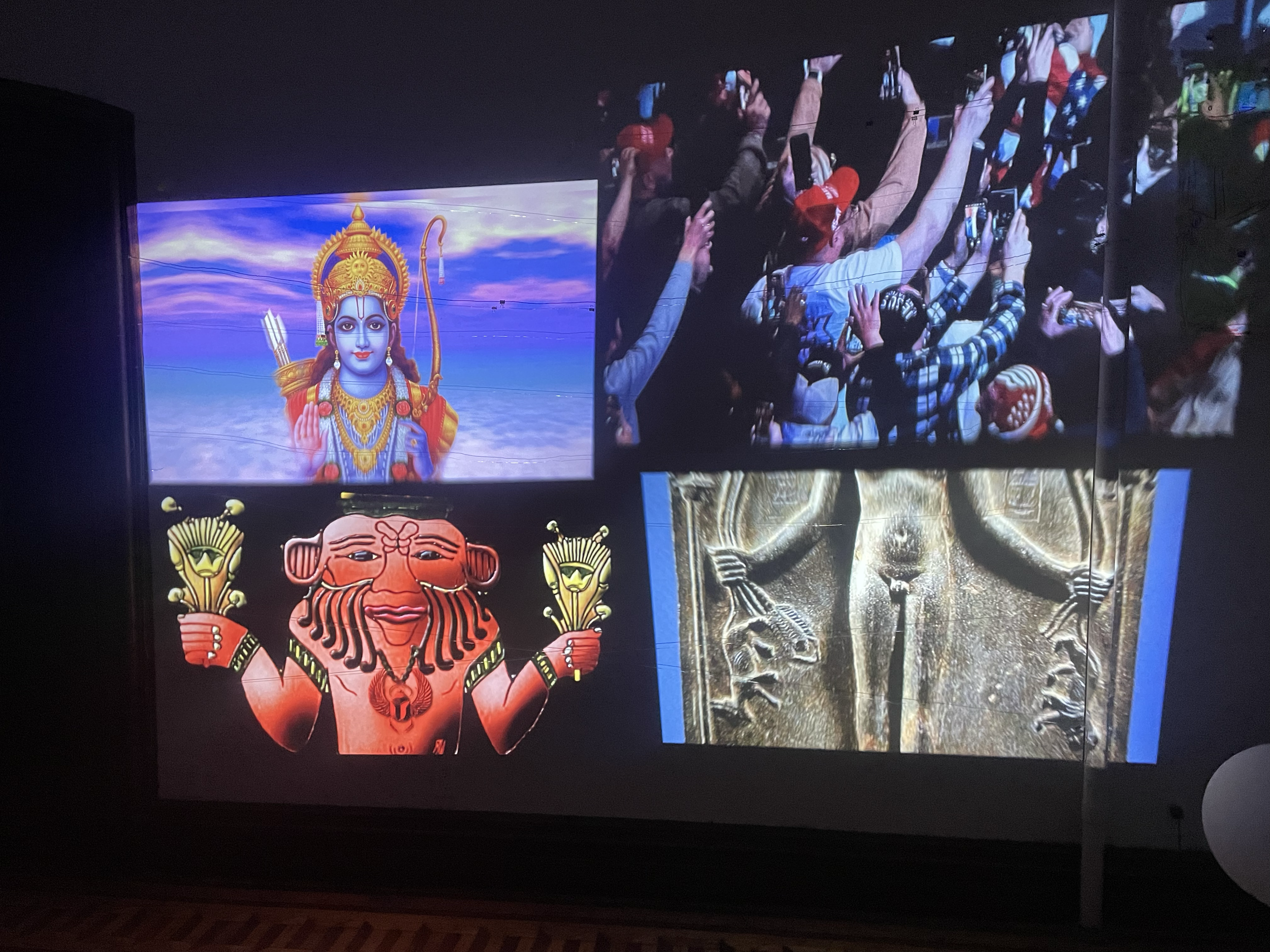
A digital screen displaying a Hindu deity, likely Lord Vishnu or Lord Rama, with a blue face, gold crown, and jewelry. To the right, there is a large crowd of people taking photos or videos with their smartphones, some wearing red caps.
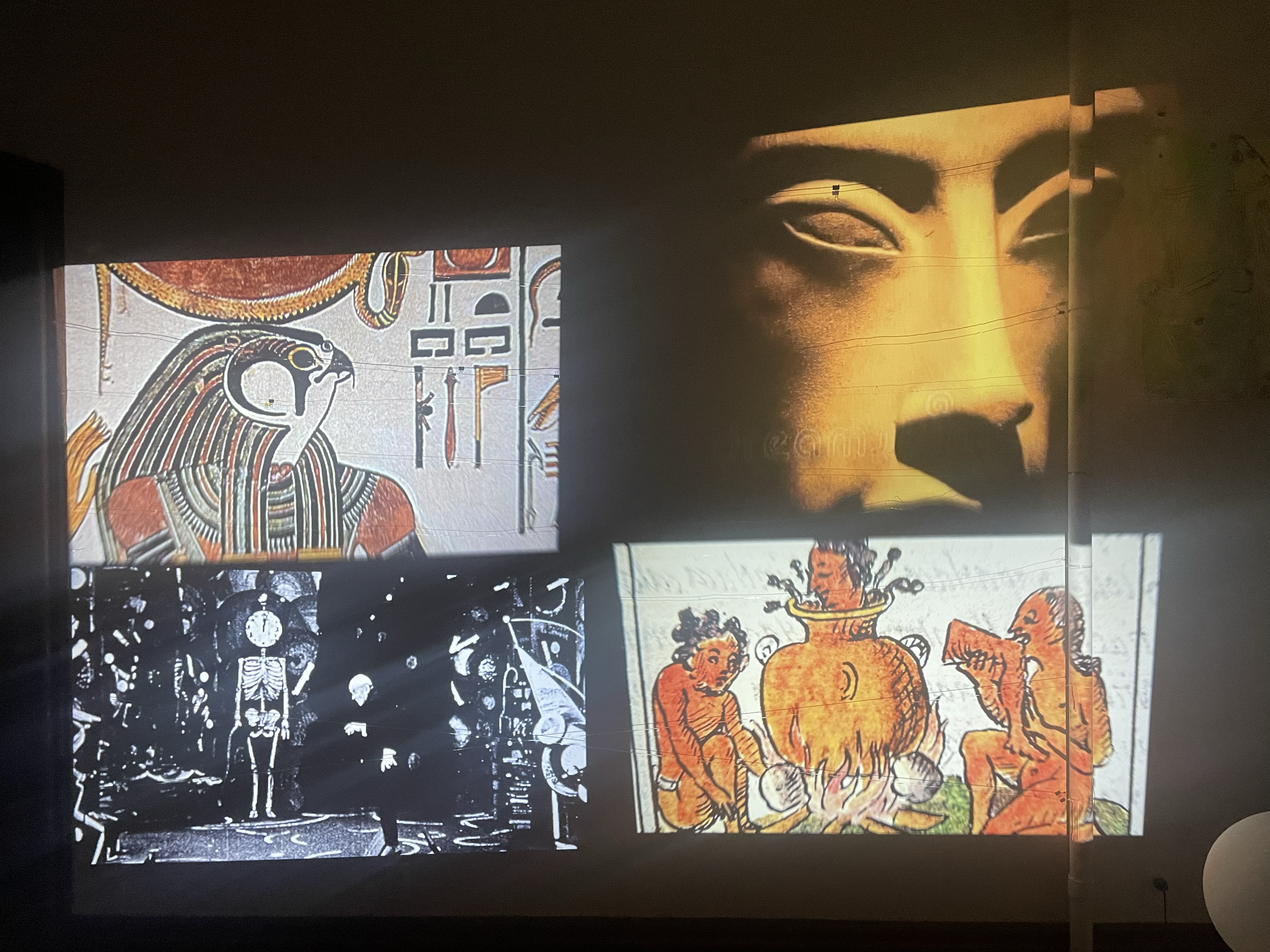
Multiple posters featuring ancient Egyptian art and mythological figures are displayed on a wall in a dimly lit room.

A collection of colorful, festive artwork including a skeleton figure, a clown, and a mountain scene, likely related to Day of the Dead celebrations.

A collage of images including a cartoon character with glasses and dark hair, a historic artwork depicting mythological figures, a black-and-white photo of a smiling man, and a scene of people walking through a debris-filled area with orange flowers. The scene appears to compare or comment on culture or history.

A collage of four different images, including a sunset over a city, a close-up of a face in a colorful digital art style, graffiti art on a wall, and a graphic drawing of people with a dog, with handwritten notes and sketches around.

A collage of four different artworks and scenes: a black and white photo of a person riding a bicycle under trees; a detailed, ornate building with graffiti on a wall in front; a portrait of a person with glasses and a cap holding a robotic head; an abstract art piece with multiple hands and organic shapes.

A projection of a computer screen showing a Google image search results page with various artwork images and related links.

A collection of black and white photographs and an illustration. The photographs feature people, including a woman with braided hair and choker necklaces, and a man in a military uniform. The illustration depicts a stylized red tree with a face, set against a white background.

A collage of images including historical black and white photographs, a protest scene with people holding flags, red paint splatters resembling blood, and a quote about imperialism.

Wall with multiple digital and hand-drawn images, including a close-up black and white eye, colorful futuristic cityscape, and a person holding a tablet, in an art exhibit setting.

A display featuring black and white historical photographs and colorful illustrations. The photographs show scenes of soldiers, a street with banners, and a group of people. The illustrations depict traditional Asian figures and colorful scenes.

Multiple historical photographs and paintings displayed on a dark wall. The top right features color landscape photos of mountains and a river, while the bottom left shows traditional Asian artwork with religious figures, and the bottom right contains black and white vintage photos of groups of people.

A street scene at night with a large black-and-white mural of a woman’s face on a wall, illuminated by streetlights. Nearby, there is a market stall or shop with warm yellow lighting, displaying various items and people shopping or working.

A collage of four images: the top left shows people swimming in a pool, the top right depicts a painted scene of people on horseback and walking on a street, the bottom left features a woman in a formal outfit with a drink, and the bottom right displays a man and woman walking with dogs in a street scene.
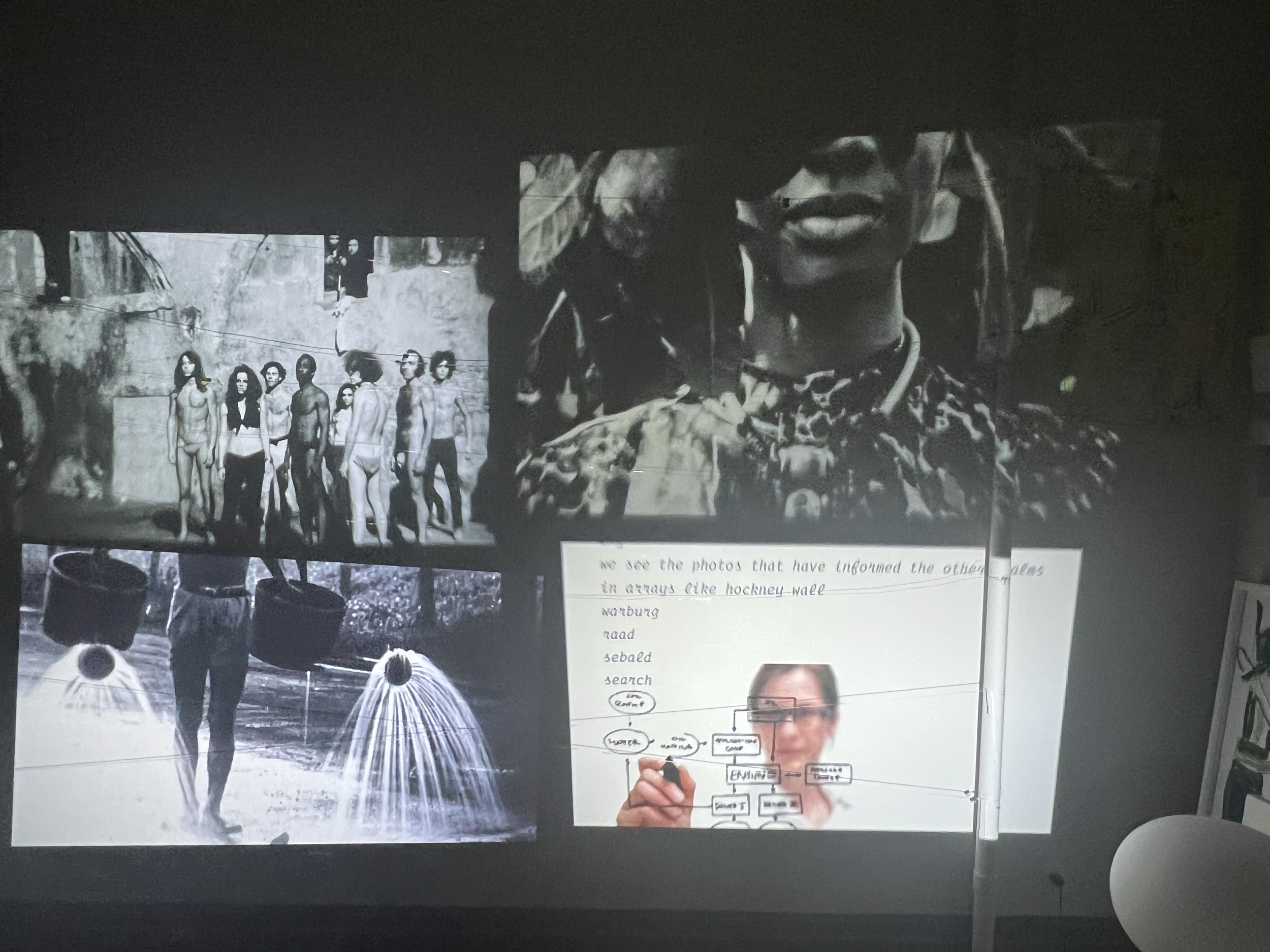
A series of black-and-white photographs and sketches displayed on a wall, including a group of naked people standing in a line, a close-up of a person's face with tribal face paint or mask, and a person holding a camera or phone, possibly taking a photo or recording, with handwritten notes or sketches next to the images.

A collage of black-and-white photos depicting historical scenes, including a group of men sitting outdoors, a person working with a plow on a hillside, and a person in traditional attire. A partial modern photograph of children and adults, possibly at a fair or event, is visible at the bottom right.

Photograph of a wall displaying a collage of various artworks, including black-and-white portraits, colorful masks, and illustrations.

Multi-panel art installation featuring vintage black-and-white photographs of people, a scenic coastal landscape, and abstract shapes and sculptures.

Projection of a Hindu goddess with a crown and jewelry on a large screen, and a crowd of people taking photos.

The image shows a computer screen with a mix of visual elements, including a person’s face at the bottom right, partly visible, wearing glasses and earrings. On the screen, there is text mentioning 'HAREMS' and 'Chastity,' along with images of art and sculptures related to ancient civilizations and a sketch of an island landscape.

A collage of images including a colorful traditional painting of Hindu deities, a black-and-white statue, and a painted scene of people, all displayed on a wall.

A split display of ancient Egyptian hieroglyphic art and a black-and-white sculpture of an Egyptian figure.

Four divided posters on a wall: colorful Buddhist artwork depicting a seated Buddha with surrounding figures, a monochromatic black and white landscape, a simple cartoon-style figure with text, and a detailed carved stone sculpture of an animal head.

A collage of images including a landscape with power lines, a skeleton figure, abstract art with swirling lines and a flame, and a woman wearing traditional attire.

A wall with four posters, including one of a tree with what looks like carved faces, a spooky face mask, a masked figure, and two intricate, symmetrical designs with floral patterns.

A display of various masks, including some that are anatomically correct with exaggerated or artistic features, arranged in a grid pattern.

A collage of images including a black and white photo of soldiers, a large crowd of people, a fireworks display, and landscape scenes.

Collage of black-and-white and color images depicting various scenes of people, including a group of five people in traditional attire, a person walking under an umbrella, a group of people gathered outdoors, and a person with painted face and colorful attire.

The image shows three large panels with different images. The left panel features a colorful illustrated landscape with cliffs, ocean, and people on a grassy area. The middle panel displays a black-and-white photo of people walking on a busy street. The right panel shows silhouettes of two people riding a horse against a warm yellow background.

Multiple photographs and images displayed on a large screen in an indoor setting, including landscapes, historical black-and-white photos of young people, and artistic images of human legs, with people observing in the background.

A series of illuminated historical paintings and murals depicting various scenes, with one showing a protest or demonstration with people holding banners and raising fists, another showing ancient artifacts or scenes, and others featuring traditional cultural imagery.

The image contains a collage with a black and white artistic drawing on the left, a vibrant blue light projection in the center, and a portrait of a man in military uniform on the lower right. There is also a red graphic of a tree with leaves on a white background in the lower left corner.

Photograph of a display board with artwork depicting an abstract face and hanging photos of a large group of people, mostly women, wearing glasses and smiling.

A man with gray hair, wearing a black leather jacket, tan pants, and a red scarf, stands in a room with wooden floors and walls. He is looking at a large digital screen displaying photos related to a documentary titled 'Tokyo Ghetto Pussy - Fly Me To The Moon.' There are paintings and books around the room, and the room is decorated with a wooden arch and a floral paper decoration on the wall.
**Like Warburg, my work has long engaged with the collection, analysis, and recontextualization of images. Over the past quarter century, I have built an extensive archive—both a lens and a labyrinth—exploring how images function across time and space. This Atlas of Images extends Warburg’s vision into the digital age, incorporating the ideas of Walter Benjamin, John Berger, Marshall McLuhan, Jacques Rancière, Gerhard Richter, Hito Steyerl, and others to examine contemporary image circulation, digital culture, and global visual literacy.
Here are some of the ways the hidden patterns and their disruption of familiar seeing will emerge in the installation:
1. Rhythms of Power and Resistance
- When protest imagery from different eras and cultures are placed together, viewers suddenly see common gestural languages: raised fists, forward strides, collective movements
- Religious iconography juxtaposed with political imagery reveals how power has consistently used similar visual strategies across time
- The repetition of crowd scenes across different contexts shows how mass movements adopt and adapt visual languages
2. The Body as Historical Document
- Postures of authority repeat across centuries and cultures
- The choreography of labor appears in unexpected places
- Gestures of devotion, whether religious or political, share surprising similarities
- The way bodies are arranged in space (in ceremony, in protest, in celebration) follows recurring patterns
3. Breaking Familiar Narratives
- By placing a Chinese scroll next to modern propaganda, viewers are forced to reconsider both
- Religious imagery alongside contemporary advertising reveals unexpected continuities
- The juxtaposition of personal photographs with historical documents creates new readings of both
4. Visual Syntax Across Time
- The way images are composed (central figures, hierarchical arrangement, use of symbols) shows persistent patterns
- Color schemes carry cultural and emotional weight that transcends their original context
- Spatial arrangements (high/low, center/periphery) reveal enduring power structures
5. Disrupting Temporal Flow
- By placing ancient and modern images together, the installation breaks our habit of seeing history as linear
- Contemporary images suddenly appear ancient; ancient images feel startlingly relevant
- The familiar becomes strange through unexpected contextual shifts
This kind of curation challenges viewers to:
- Question their automated responses to familiar images
- See connections across time periods they normally consider separate
- Recognize how contemporary visual culture builds on historical patterns
- Understand their own role in perpetuating or breaking visual traditions
The power lies in making visible what we usually process unconsciously - the grammar of images that shapes our understanding of the world. When these patterns are exposed, viewers can no longer see images as isolated instances but must confront them as part of a complex, ongoing visual dialogue across time and culture.